
The Man Who Never Called Himself an Artist |
As Beaumont's art museum marks 75 years this summer, its most enduring exhibit began in a stranger's front yard, and almost got lost to storage and hurricanes twice before anyone gave it a permanent home. |
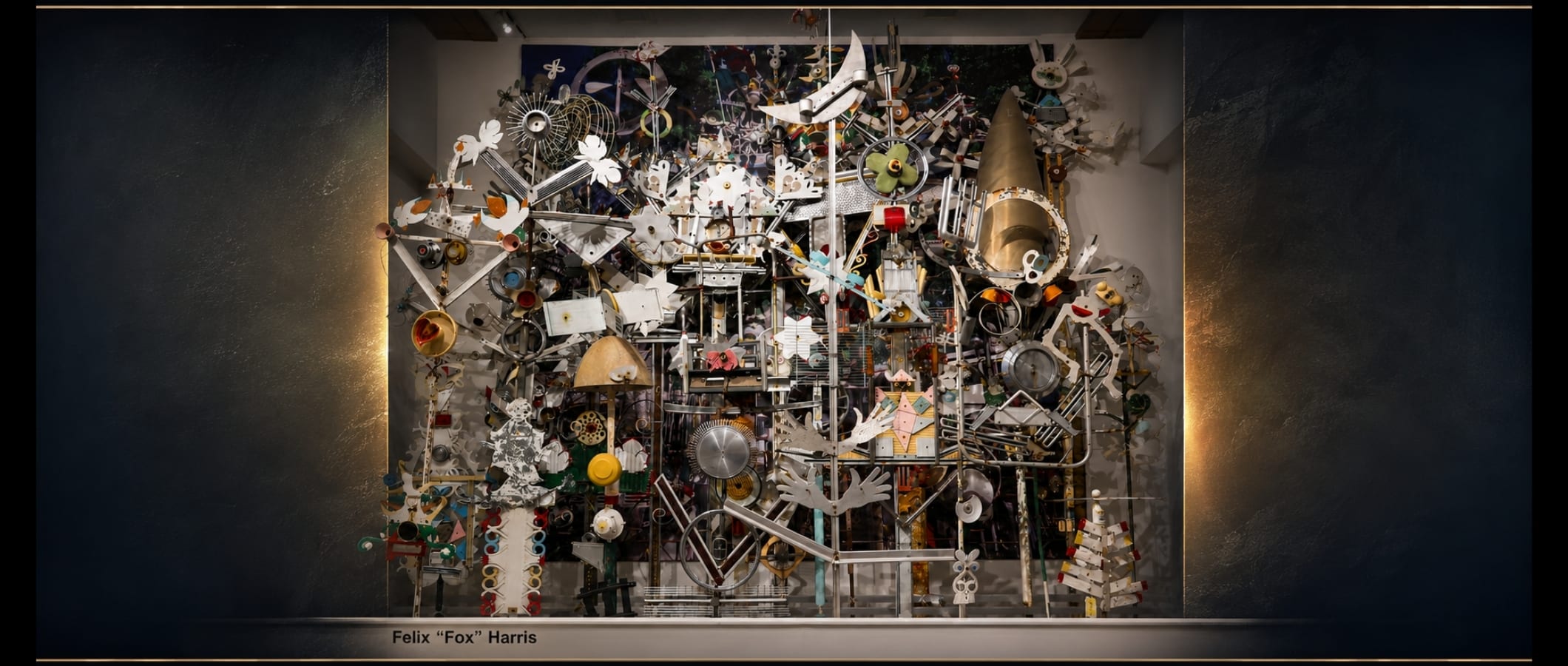
The Art Museum of Southeast Texas is spending 2026 celebrating 75 years since it opened as the Beaumont Art Museum in a rented two-story house on Calder Avenue. This summer it opened the second half of an exhibition tracing that history decade by decade, through the artworks, gifts, and people who built it. That milestone is worth noting on its own. But the museum's most enduring collection did not come from a donor with a checkbook. It came from a man named Felix Harris, known to everyone on his street as Fox, who worked as a foreman on a crew laying railroad track and never once considered himself an artist.
For more than twenty years, Harris built a forest of totems in his yard on Ledet Road in Beaumont's north end, some as tall as eighteen feet, made from scrap metal, broken toys, and street signs he shaped with a ball peen hammer and whatever tools he had on hand. He could not read, and could write only his own name. Neighborhood kids called him the Voodoo Man and ran when the wind made the pieces hum. Harris described it simply: he had come to see the work as a way to stop dwelling on his troubles and build something worthwhile out of whatever he could find.
He meant that literally. Harris never sold a single piece. He built them, arranged them carefully, and let them stand as his own private forest for two decades, with no audience in mind beyond himself and whoever happened to walk past. When he died in 1985, his family gave the entire collection to the Art Museum of Southeast Texas.
What happened after that is its own lesson in how close Beaumont came to losing this. The totems spent years being installed outdoors, taken down ahead of hurricanes, questioned by some in the community, and stored away for long stretches with no permanent home. It was not until 2007, twenty two years after Harris died, that the museum finally gave the collection a dedicated gallery built to resemble the yard where it began.
That gallery is a large part of why the museum's staff can say, with real confidence, that Beaumont helped shape what folk art means in Texas. A man with no formal training, no gallery representation, and by his own account no interest in being called an artist built something so singular that it took a museum decades to figure out how to properly hold onto it. Beaumont did not import its cultural identity from somewhere else. In at least one case, it grew out of a front yard and refused to be thrown away. |
0 Comments
Join the conversation
Be the first to comment
Share your thoughts above.